
From GREENWICH Town Centre to BLACKHEATH VILLAGE, through the ROYAL PARK
In this chapter:
- ROYAL PARK: features, artworks, historic buildings, archaeological rests. The East part of the Park (East of Blackheath Ave.) constitutes first route
- MAZE HILL: VANBRUGH CASTLE and OLAUDAH EQUIANO
- NATIONAL MARITIME MUSEUM. Its grounds from E to W is a second route
- West part of the Park, after the NMM - ROYAL OBSERVATORY - RANGER’S HOUSE


Welcome to a World Heritage Site!
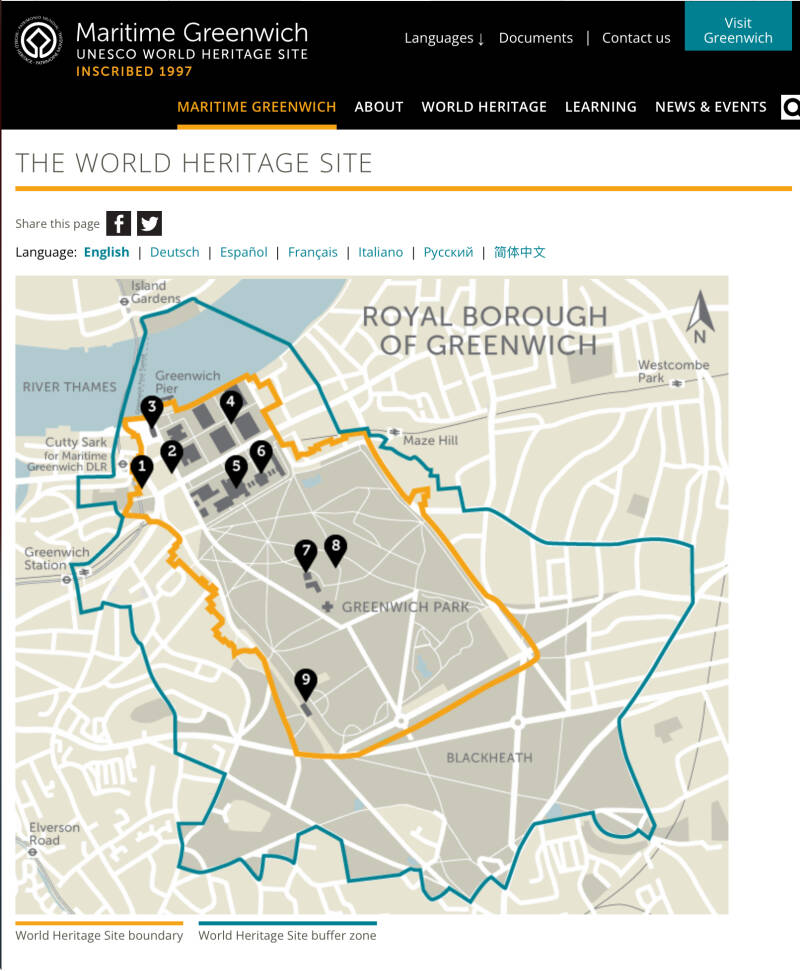

Maritime Greenwich World Heritage Site is a collection of attractions important to maritime history within central Greenwich and Greenwich Park.These include the Cutty Sark, the last surviving tea clipper ship, the Royal Obs. and the Old Royal Naval College, a Baroque masterpiece.


From the Park Row end of the NMM grounds (E side)

Why not a little detour: to PARK VISTA, when exploring the EAST and SE side of the ROYAL PARK?. See previous chapter
THE PLUME OF FEATHERS P.H.

MERIDIAN LINE MARK

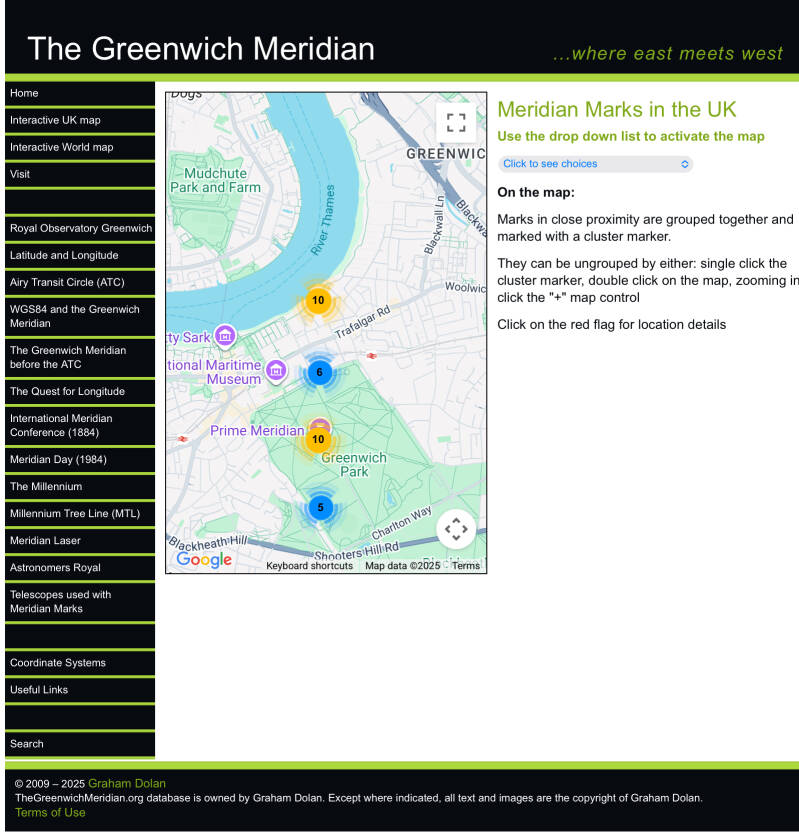
TheGreenwichMeridian.org database is owned by Graham Dolan. Except where indicated, all text and images are the copyright of Graham Dolan.
Houses

Inside the Royal Park (EAST side of THE AVENUE)
The ROYAL PARK features West of THE AVENUE are dealt with after the NMM
All Lodon’s Royal Parks

History of the Royal Park
In 1427, Humphrey Duke of Gloucester – brother of Henry V –inherited the land, Park in 1433. He built a tower on the site of what is now the Royal Observatory. When he died in 1447, Margaret of Anjou, the wife of King Henry VI, seized the estate and renamed it the Manor of Pleasance or Placentia.
Henry VIII introduced deer to Greenwich Park..
In the 1600s, the Stuarts transformed the park. King James I replaced the fence around the park with a brick wall double a man’s height – much of which still exists.
King James gave the palace and the neighbouring park to his wife, Queen Anne – allegedly as an apology for swearing at her in public when she accidentally shot one of his favourite dogs! In 1616, Queen Anne commissioned Inigo Jones to design her a special home – the Queen's House.
In the 1660s, King Charles lI commissioned the famous Andre Le Notre, gardener to Louis XIV of France, to design a bold new landscape for Greenwich Park. Le Notre’s ‘Grand Plan’ created a formal layout of tree avenues framed by banked landscaping that can still be seen today, 350 years later.
King Charles II was a keen supporter of scientific research, and he commissioned Sir Christopher Wren to build the Royal Observatory, naming it Flamsteed House after the first Astronomer Royal, John Flamsteed.
Greenwich Park's royal star began to wane in the 1700s and James II was the last monarch to actually live at the Palace. The park was opened first to the veteran sailors housed at the imposing Greenwich Hospital close to the park, but by around 1830 all members of the public were welcomed too.
During the First World War, some of Greenwich Park was used for allotments, and people were allowed to continue growing their own even after the war ended.
The park was home to three air raid shelters during the Second World War, providing protection for hundreds of local residents. During the long hot summer of 2019, 26 Royal Parks volunteers and professional archaeologists discovered the main air raid shelter in front of the Queen’s House, almost entirely intact!
1894. An anarchist bomber plants…a bomb!
The main terrorist incident connected to Greenwich Park was an anarchist bomb attack in 1894, which is considered possibly the first "international terrorist" incident in Britain. The perpetrator was 26-year-old French anarchist named Martial Bourdin.
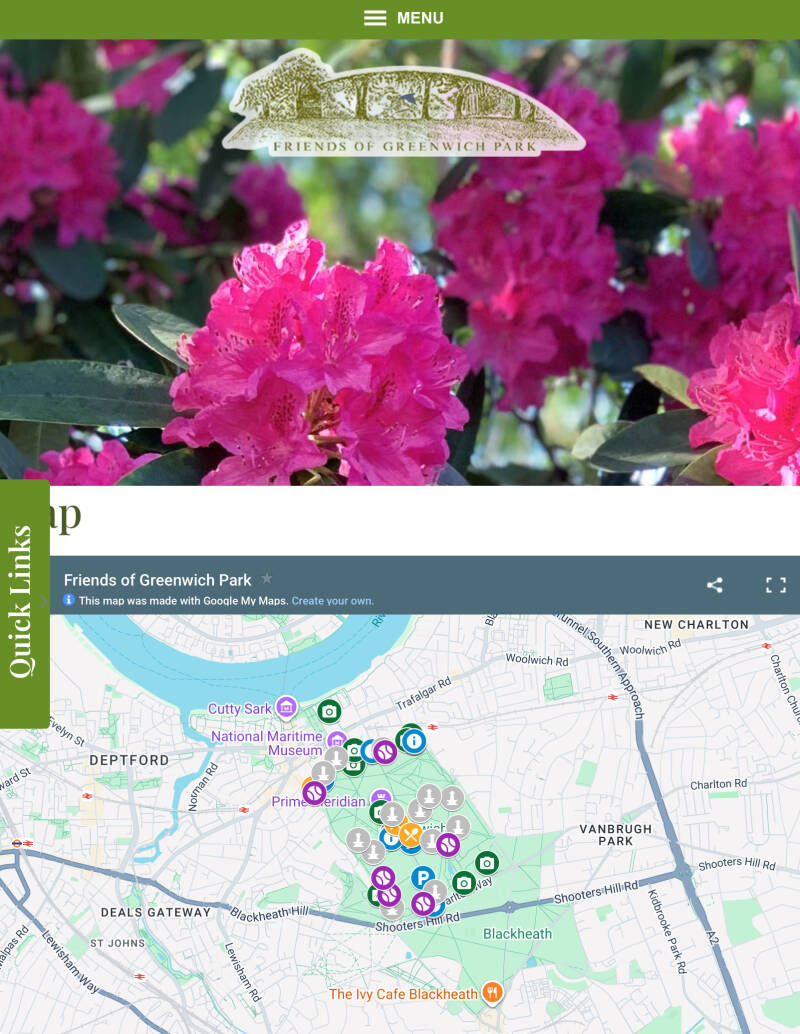
Map from the Friends of Greenwich Park
QUEEN’S ORCHARD
MILLENIUM SUNDIAL
Installed next to the Greenwich Meridian in 2000, this double horizontal dial not only tells the time but also the direction of the sun.
The Millennium Sundial was designed by Chris Daniel, chairman of The British Sundial Society, and consists of a 3m triangular metal sundial and floor mosaic.
One Tree Hill vista point
Remains of air raid shelter and and air barrage balloon
WATER CONDUIT HOUSE
Site of the ROMAN TEMPLE. Are you close to the course of WATLING STREET?
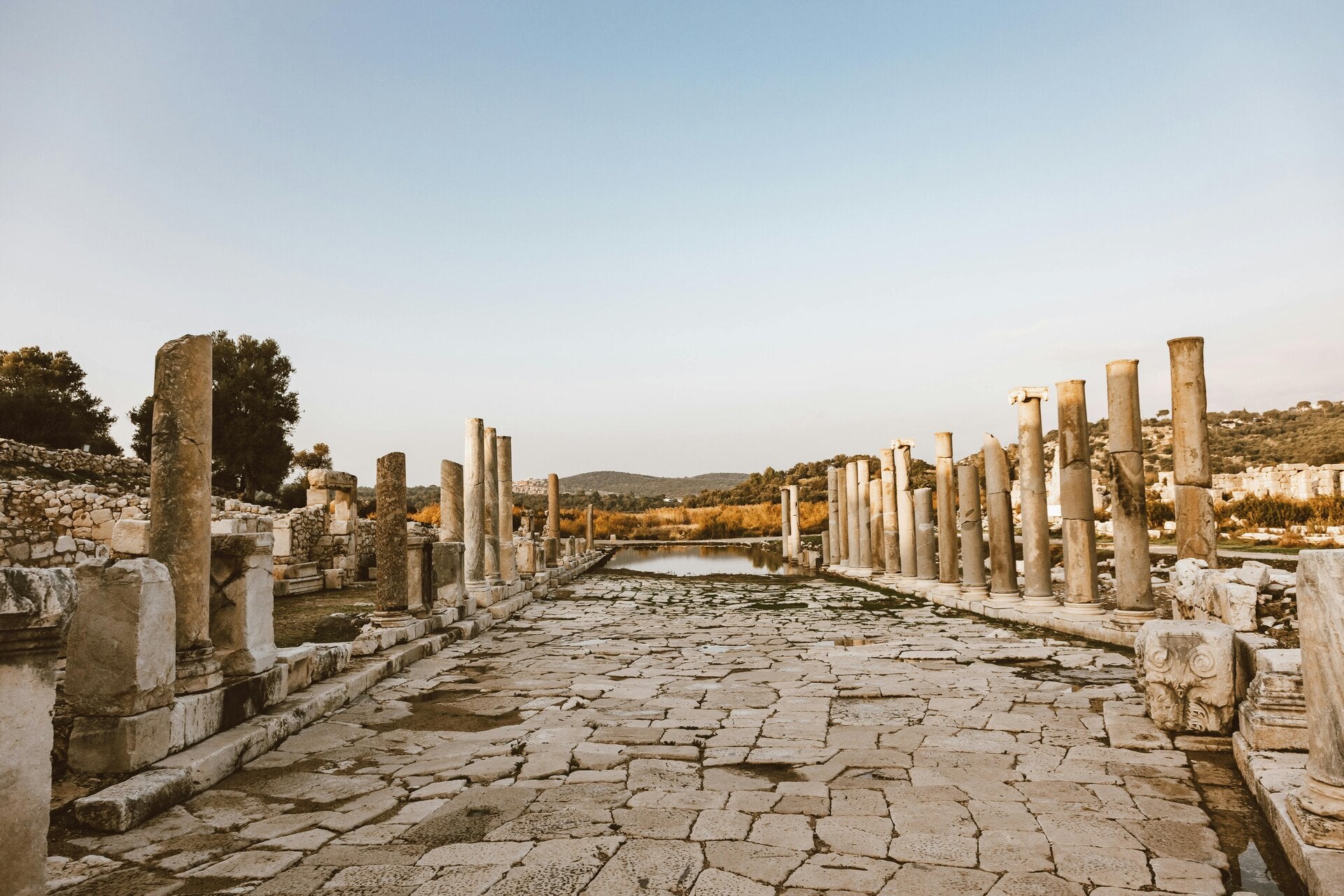
The Roman road Watling Street likely ran through Greenwich Park, with a possible route identified by the line of the park's Old Dover Road, though this is still debated among historians. Evidence for the road's presence in the area includes Roman tiles and pottery discovered near Hollyhedge House, according to Historic England and Sabre Roads. The location of an ancient Roman temple was likely chosen for its commanding view of the Thames and its easy access from the important Roman road, notes Friends Of Greenwich Park.
While the route through Greenwich Park is the most popular theory, it is not universally accepted, as a Royal Commission once decided the Old Dover Road was not part of the original Roman road, says johnchaple.co.uk.

Maze Hill (street) is very close
OLAUDAH EQUIANO lived here: the leading black campaigner for the abolition of the transatlantic slave trade
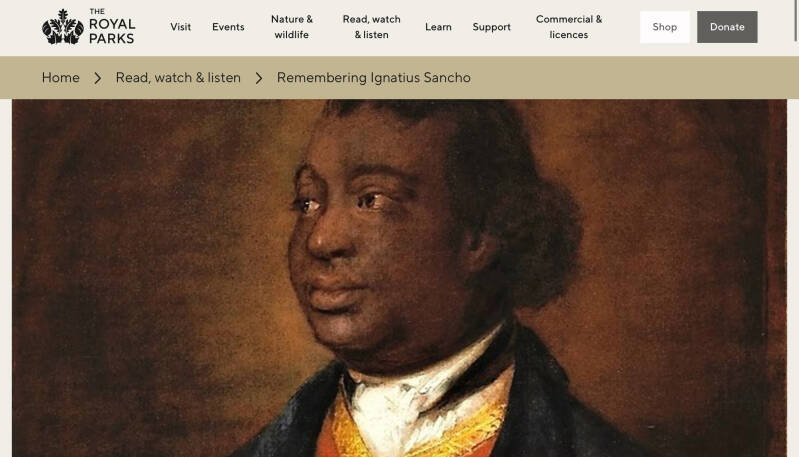

Olaudah Equiano stayed at 111 Maze Hill in Greenwich, London, in 1767 after buying his freedom. A blue plaque has been placed on the building to commemorate his visit to the home of the Guerin sisters, where he briefly stayed before pursuing his plans to become a hairdresser.
VANBRUGH CASTLE

Playwright and architect. Born in the parish of St Nicholas Acons, London, of Flemish descent. Worked in the English Baroque style, sometimes with Hawksmoor, on Castle Howard and Blenheim Palace. Lived at the self-designed Vanburgh Castle 1719-26, and died at the house he had built for himself in 1701 at Whitehall (demolished in 1898).
SIR JOHN VANBRUGH built the house for himself while Surveyor to the nearby Royal Naval Hospital in Greenwich. He lived here 1719-26. Said to be modelled on the French Bastille, where Vanbrugh was imprisoned, 1690-92, on charges of spying for the British.
Vanbrugh was arrested as a spy in Calais, France, in 1688 after working to help bring William of Orange to power, which led to the Glorious Revolution. His imprisonment, which included time in the Bastille, lasted for over four years. While imprisoned, he occupied himself by writing plays and, after his release, his experiences influenced his architectural work and his later career as a playwright.
Deer paddock
IGNATIUS SANCHO café
The café building was previously a private, residential lodge and sits within a newly landscaped space called Vanbrugh Yard, which has been transformed from a concrete yard into exciting community facilities. In addition to the café, there are accessible toilets, a volunteer hub, and a community kitchen garden.

Outside the Park, on your way South, to (or from) Blackheath Village, Blackheath Standard or Kidbrooke
BLACKHEATH WAR MEMORIAL
GIBBS SHELTER and FOUNTAIN
He was one of the first aldermen of the Borough of Greenwich. He died in 1908, and left a sum of money in his will for a drinking fountain to be built. There was enough money left for a shelter to be built too.

To the S, not far away
LONDON MARATHON starting point
Plaque in memory of the CORNISH REBELS
BLACKHEATH GATE
Back inside the Park, Northwards (towards the town centre)
Buses to CENTRAL LONDON, CHARLTON, WOOLWICH, BLACKHEATH STANDARD, BLACKHEATH VILLAGE: https://tfl.gov.uk/bus/stop/490007512T/greenwich-park
QUEEN ELIZABETH OAK (1292!… but it died long ago)
The tree sadly died in the nineteenth century but remained standing until 1991, when it fell during a storm. You can still see it in the Park, though, where it is marked with a special plaque.
Over the centuries, many tales have been told about this legendary tree. As its name suggests, some of these stories have a royal connection.

BANDSTAND
THE PAVILION café

You are now very close to the ROYAL OBSERVATORY (scroll down)

Back to a different route, along the NMM grounds
NATIONAL MARITIME MUSEUM grounds (East to W, starting at Park Vista)

The museum was created by the National Maritime Museum Act 1934[2] under a Board of Trustees, appointed by HM Treasury. It is based on the generous donations of Sir James Caird (1864–1954). King George VI formally opened the museum on 27 April 1937 when his daughter Princess Elizabethaccompanied him for the journey along the Thames from London. The first director was Sir Geoffrey Callender.[3]
The museum was established within the 200 acres (0.81 km2) of Greenwich Royal Park in the buildings formerly occupied by the Royal Hospital School, before it moved to Holbrook in Suffolk.
Anchors Park
At the Park Row end of the Museum's grounds is Anchor Park. This 'park' of anchors has been in situ for many years and can be easily missed by visitors, who generally enter the grounds from the western side of the grounds. The largest anchor in the park is from the Royal Yacht Victoria and Albert, which was launched in 1899 and scrapped in 1954.
Anchors are the most commonly encountered maritime relics on the seabed. With their barbed flukes, anchors were very prone to becoming embedded in the sea floor, making it impossible to raise them to the surface. When this happened, the only option was to sever the anchor chain, leave the anchor in the sea bed and replace it with another.
Anchor fouling was generally caused by the chain or rope becoming entangled around the stock or flukes, or by the anchor becoming lodged by an obstruction. Very large ships would often use several anchors to ensure the ship always had a means of being held fast.
Administration building
Along North gardens: railway tunnel
The gardens immediately to the north of the museum were reinstated in the late 1870s following construction of the cut-and-cover tunnel between Greenwich and Maze Hill stations. The tunnel comprised part of the final section of the London and Greenwich Railway and opened in 1878.
The decision to build a tunnel was influenced by concerns raised by the Astronomer Royal, Sir George Biddell Airy, who was worried about the potential disruption (vibrations and magnetic interference) that surface trains might cause to the sensitive instruments at the nearby Observatory.
Colonnade
The original Queen's House was designed by Inigo Jones starting in 1616, completed by 1635, and built over a public road to connect the two sides of the royal grounds.
19th-Century Additions: From 1806, the house was used for the Royal Hospital School. To accommodate more students, new wings were added to the east and west of the original building, connected by the new colonnades.
Architect: Daniel Asher Alexander designed these 19th-century colonnades.
The QUEEN’S HOUSE


Queen's House is one of the most important buildings in British architectural history, due to it being the first consciously classical building to have been constructed in the country. It was Jones's first major commission after returning from his 1613–1615 grand tour[1] of Roman, Renaissance, and Palladian architecture in Italy.
Jones is often credited with the introduction of Palladianism with the construction of the Queen's House. Jones' unique architecture of the Queen's House also includes features like the Tulip Stairs, an intricate wrought iron staircase that holds itself up, and the Great Hall, a perfect cube.
It was built between 1616 and 1635, commissioned by Queen Anne of Denmark and her successor as queen consort, Queen Henrietta Maria. The House was a royal retreat and place to display and enjoy the artworks the queens had commissioned; this included the ceiling in the Great Hall that featured a work by Orazio Gentileschi titled Allegory of Peace and the Arts.
After its brief use as a home for royalty, the Queen's House was incorporated into use for the complex of the expanding Royal Hospital for Seamen, and maintaining its clear axial view down to the river was largely responsible for the dramatic layout of the later English Baroque hospital. Neoclassical colonnades wings and buildings were also added to the House in the early nineteenth century for a Seaman's school.
The House has returned to the display of artwork, it now serves as part of the National Maritime Museum and is used to display parts of its substantial collection of maritime paintings and portraits.
Former school, now Main Museum Building. The National Maritime Museum is the world’s largest museum of seafaring.
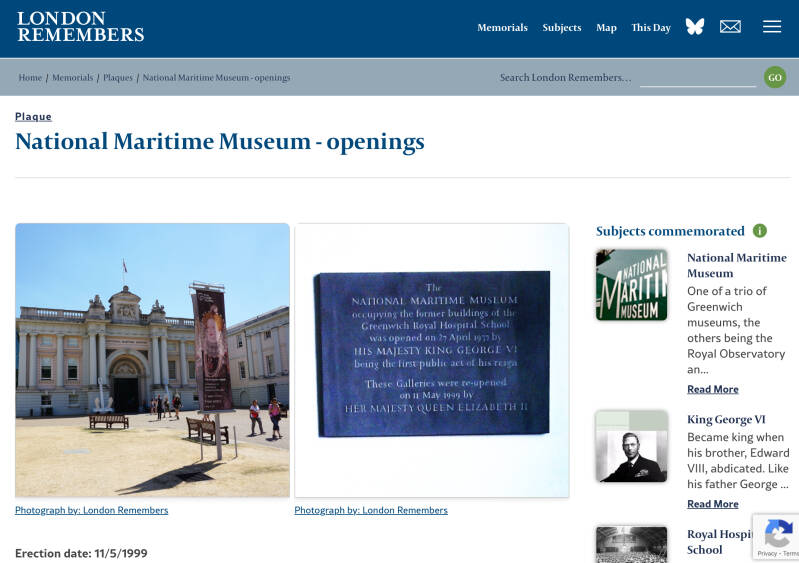
PLAQUE:The buildings of this museum were occupied until 1933 by the Royal Hospital School. Founded in 1694 for the sons of seamen of the Royal Navy. The ashes of many former pupils of the school have been scattered over the lawns.
LONDON REMEMBERS says: lThe school started in 1712. It was was nicknamed the 'Cradle of the Navy' because of its tradition of training future sailors. The original purpose of the school was to provide assistance and education to the orphans of seafarers in the Royal and Merchant Navies.
From 1806 the School was based in the Queen’s House, Greenwich. This function required the building to be extended with east and west accommodation wings, linked to the House with colonnades. Further extensions were added in 1876. In 1933 the school moved from Greenwich to Holbrook in Suffolk”.
The Great Map/café


Displays

Controversy
The collection of the National Maritime Museum also includes items taken from the German Naval Academy Mürwik after World War II, including several ship models, paintings and flags. The museum has been criticised for possessing what has been described as "looted art".The museum regards these cultural objects as "war trophies", removed under the provisions of the Potsdam Conference.
Learning
SCHOOLS RESOURCES: https://www.rmg.co.uk/schools-communities/schools-resources


THOMAS BOULDON MEMORIAL
JOHN SIMPSON MEMORIAL
GREENWICH HOSPITAL OLD BURIAL GROUND. MEMORIAL
In memory of the gallant officers and men of the Royal Navy and Marines to the number of about twenty thousand, formerly inmates of the Royal Hospital Greenwich, whose remains were interred in this cemetery between the years 1749 and 1869.
In 1875, after the Hospital had closed, the digging of a tunnel for the London and Greenwich Railway meant that the remains had to be disinterred. They were removed to East Greenwich Pleasaunce which in 1926 was made a public park.
The names on the monument are of men whose claim to immortality is their role in running the Hospital rather than any heroic deed. Most were 'Governor' of the Hospital, a post that dates back to 1708, though the first one listed here, Hood, was appointed in 1796. And it seems to have been standard for the Governor to stay in the post until death.
DEVONPORT HOUSE
The earliest part of this composite building was built for Greenwich Hospital as a school building in 1783-4. It was designed by the Clerk of Works, William Newton, and was intended to accommodate 200 boys.
In 1821 the Hospital took over the Royal Naval Asylum, then housed in new buildings flanking the Queen's House. The earlier school was then converted into an infirmary. A zymotic denoting contagious disease that develops after infectionward was added in 1881-2 and other smaller additions were made.
In 1923 the building was acquired by the Seamen's Hospital Society for an expansion of the Dreadnought Seamen's Hospital although the infirmary was not vacated until 1933.
By this time the first phase of Nurses Home, designed by Edwin Cooper, had already been completed, erected in 1925-9. The second phase, which included the demolition of the 1881-2 additions, was carried out in 1933-4. The nurses home was constructed on the site of the Greenwich Hospital Burial Ground ( see HOB 1170293) which had closed in 1857 and the mausoluem and surviving monuments were incorporated into its grounds. The building remained in use as nurses home until 1993.
King William Walk
"The Throne of Earthly Kings", by François Hameury within DEVONPORT HOUSE
COOPER Building, POWERHOUSE

South of the NMM
2012. London Olympics… here!

The equestrian events at the 2012 Olympic Games in London were held between 28 July and 9 August at Greenwich Park. Medals were awarded in three disciplines for both individual and team competitions.[1]
Great Britain was the most successful nation, topping the medal table with three golds and five medals in total. They were particularly dominant in team events, taking two gold medals and a silver medal from three team events.
Know more about the 2012 GAMES and the venues on www.visit-londons-east-end.co.uk
Recent discovery: AIR RAID SHELTERS, in Greenwich Park!
The park was home to three air raid shelters during the Second World War, providing protection for hundreds of local residents. During the long hot summer of 2019, 26 Royal Parks volunteers and professional archaeologists discovered the main air raid shelter in front of the Queen’s House, almost entirely intact!
TITANIC MEMORIAL GARDEN
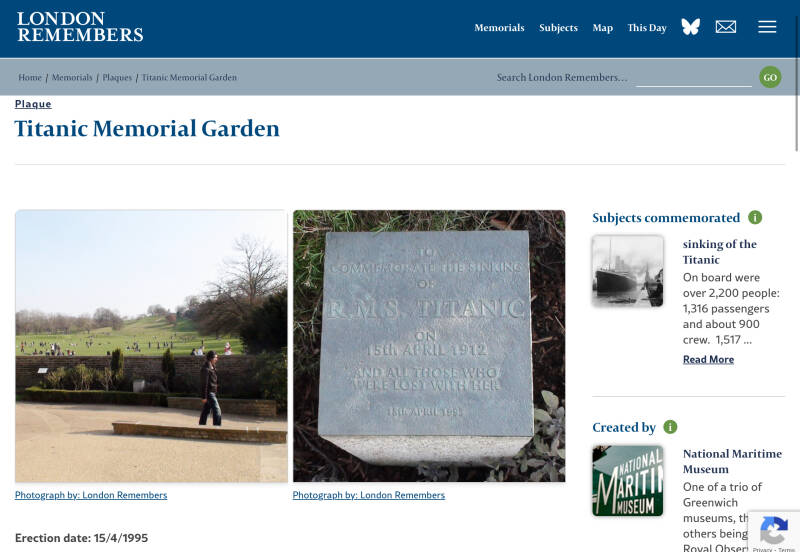
In late August 2018, several groups were vying for the right to purchase the 5,500 RMS Titanic relics that were an asset of the bankrupt Premier Exhibitions.[20]Eventually, the National Maritime Museum, Titanic Belfast and Titanic Foundation Limited, as well as National Museums Northern Ireland, joined together as a consortium that was raising money to purchase the 5,500 artifacts. The group intended to keep all of the items together as a single exhibit. The oceanographer Robert Ballard said that he favoured this bid as it would ensure that the memorabilia would be permanently displayed in Belfast (where the Titanic was built) and in Greenwich.[20] The museums were critical of the bid process set by the Bankruptcy Court in Jacksonville, Florida. The minimum bid for the auction on 11 October 2018 was set at US$21.5 million (£16.5m) and the consortium did not have enough funding to meet that amount
VICTORY, artwork by YINKA SHONIBARE
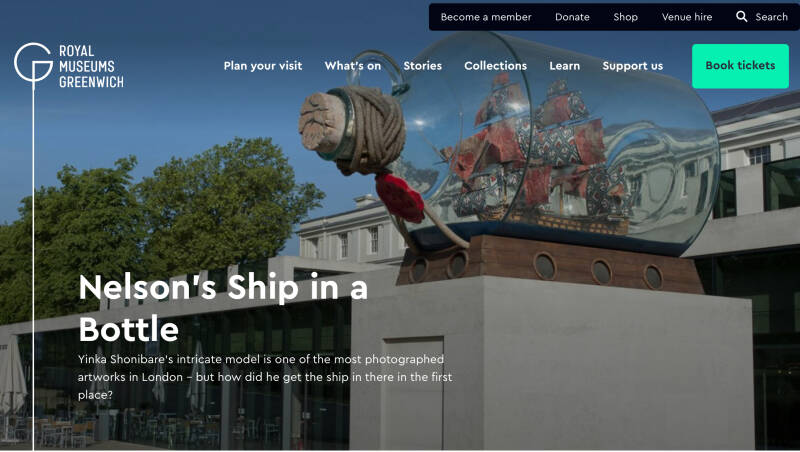
Remember it in Trafalgar Square a few years ago?

WHERE ARE NOW THE FORTH PLINTH ARTWORKS?: https://londonist.com/london/art-and-photography/every-work-of-art-on-the-fourth-plinth-so-far
KING WILLIAM IV statue
Site of ST.MARY’S Church


King William Walk
Nevada St.

GREENWICH THEATRE
YE OLDE ROSE AND CROWN P.H.
Former SPREAD EAGLE inn

OLIVER’S Jazz venue
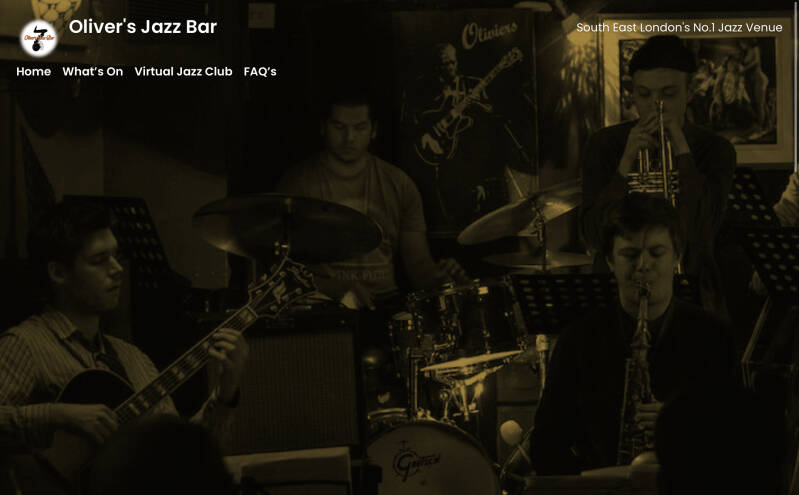
Croom’s Hill
THE FAN MUSEUM

Stockwell St.
VINTAGE MARKET
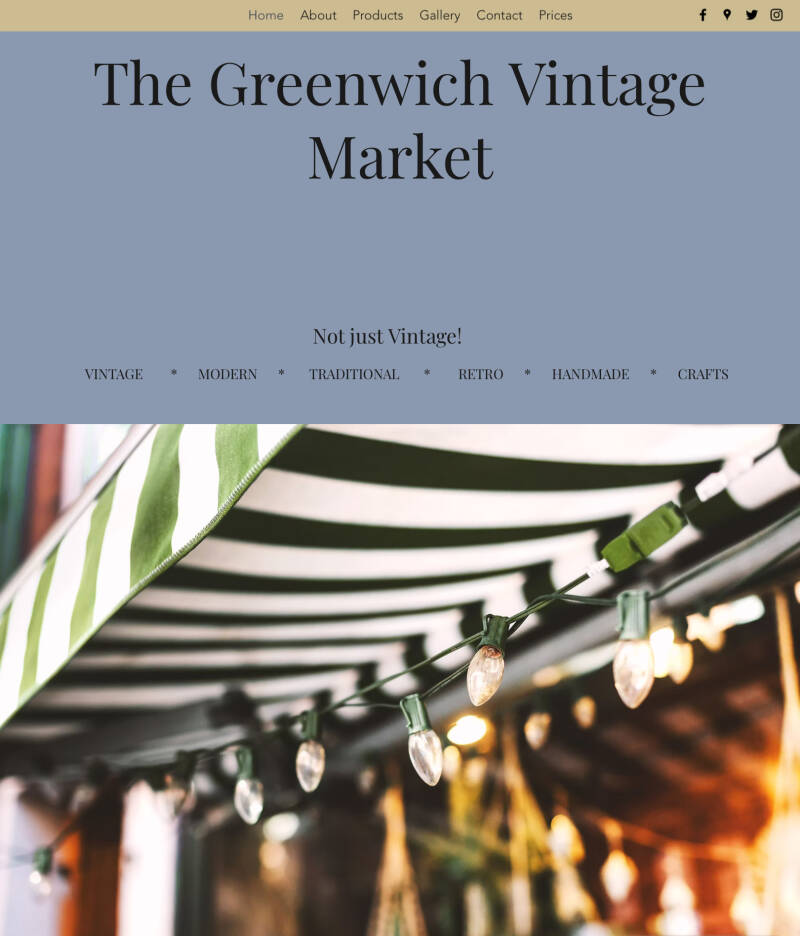
GREENWICH UNIVERSITY GALLERIES. Art exhibitions

The Royal Park, again (history of the park has been dealt above -East side)
ST.MARY’S GATES
Early C19. Central wrought iron fence with cresting of leaves and scrolls. At either side a pair of double wrought iron gates of similar pattern, hung on square wrought iron piers set diagonally. Beyond these, single side gates hung from diagonal wrought-iron half-piers set in tall, square stock brick piers with stone cornice and urn finial. At west another section of fence between ½-piers, bounded by another similar brick pier, and containing another single gate.
ST.MARY’S LODGE
A cottage orné located in the north-west corner of the park. It was built shortly after 1808 to designs by John Nash and replaced an older lodge that was in considerable disrepair.
The first occupant of the lodge was the park under-keeper, Thomas Stikeman, a former page to Caroline of Brunswick, who was the Park Ranger. She had ordered the construction of the new lodge following years of complaints about the state of the previous building.
The cottage orné style was popular at the time and was meant to evoke a sense of rustic charm.
HERB GARDEN

STANDARD RESERVOIR CONDUIT HOUSE


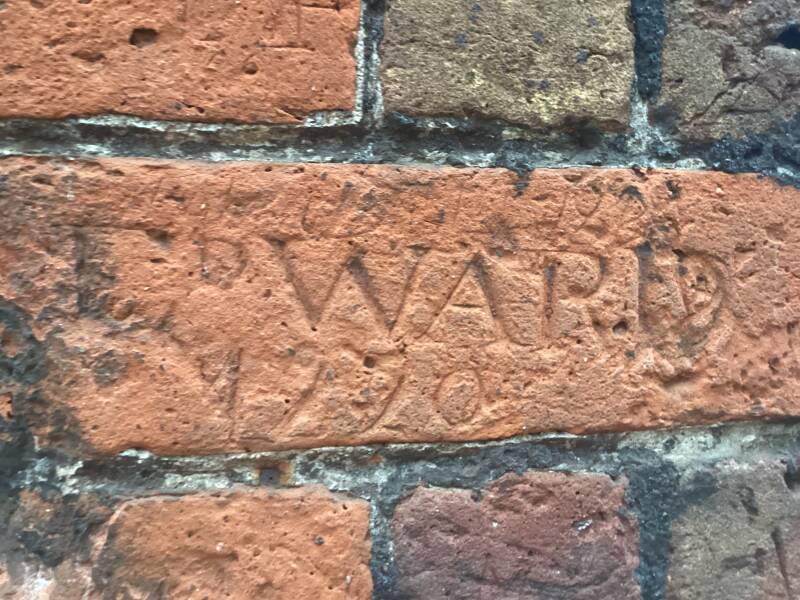
The Standard Reservoir Conduit House is designated at Grade II* for the following principal reasons: * It is a fine conduit house, covering a reservoir, attributed to the architect Nicholas Hawksmoor, Clerk of Works at Greenwich between 1698 and 1735. * It is larger and architecturally more elaborate than the already listed Conduit House at Hyde Vale (Grade II). * Conduit houses are a rare building type, and this is a particularly impressive example. * It has additional value as one of three related late C17 or early C18 conduit houses which were part of the earliest water supply for the Royal Hospital of Seamen
KNIFE EDGE, artwork by HENRY MOORE

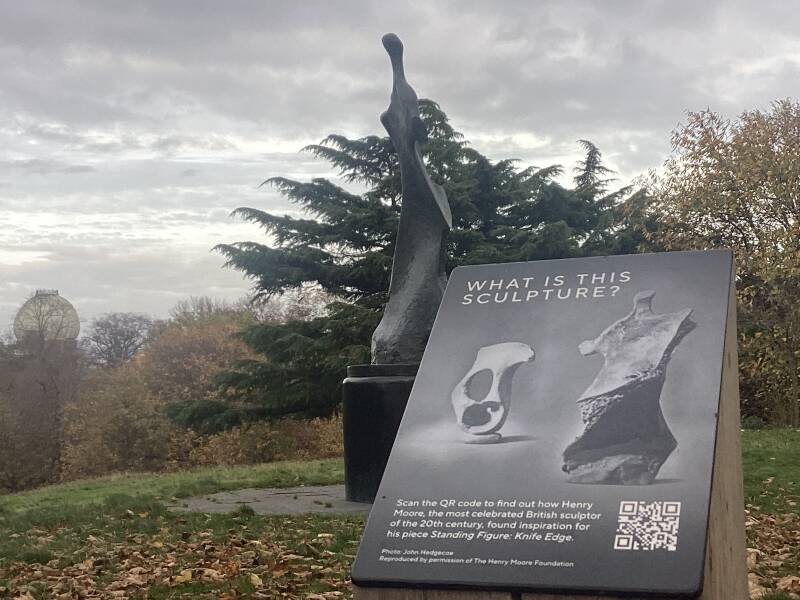
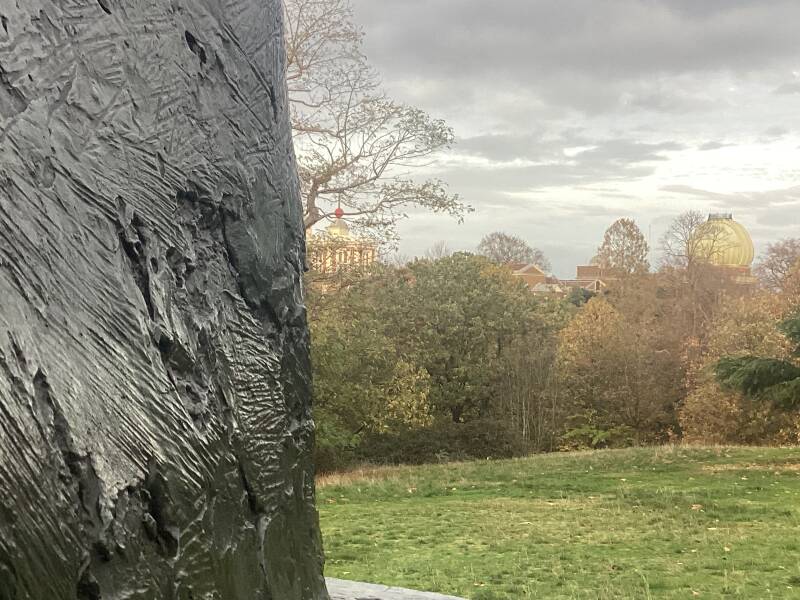
The Knife Edge is a bronze sculpture by the celebrated and prolific English semi-abstract artist Henry Moore. It was cast at the Noack foundry in Berlin and stands close to the top of the hill west of the Royal Observatory.
Henry Moore personally chose this site, having strong views that sculpture always looks best when placed in a natural landscape. It was temporarily removed in 2007 after 30 years because of fears that it might be stolen but returned in 2011 in time for the London Olympics in 2012.
ANGLO-SAXON BARROWS
WHERE to find H.MOORE’S ARTWORKS in London: https://londonist.com/london/art-and-photography/where-to-find-henry-moore-sculptures-in-london
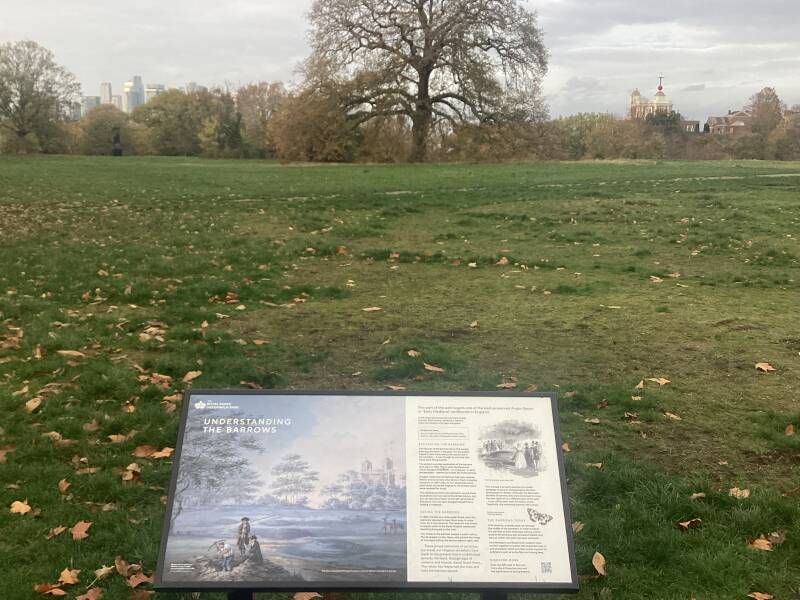
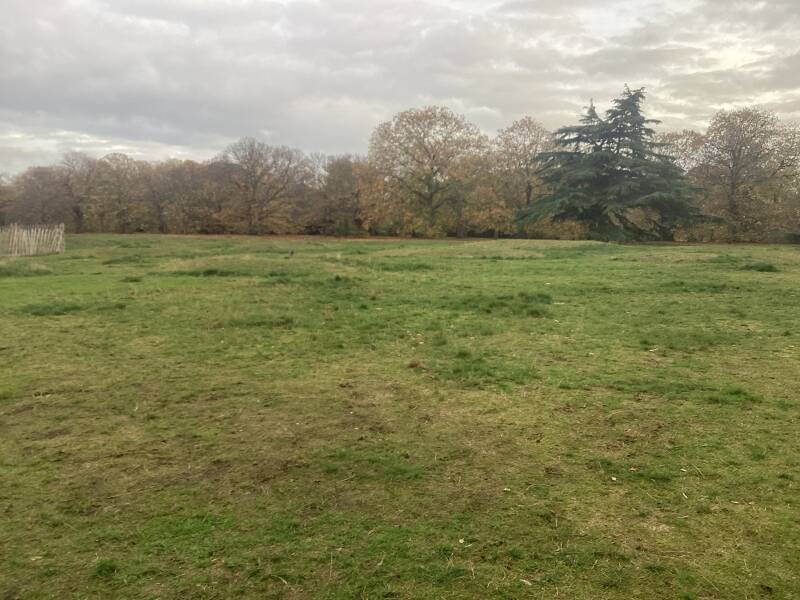
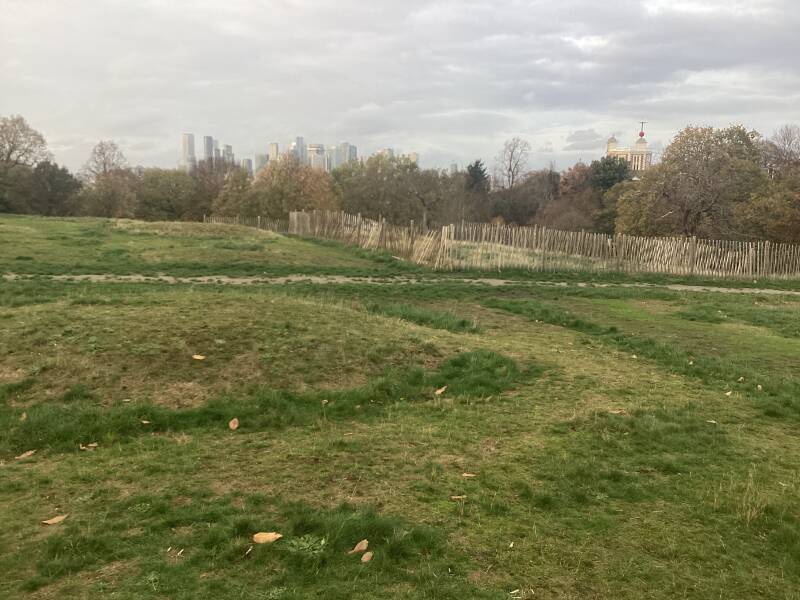
Greenwich Park has an exciting secret. Did you know that the park is home to one of England’s best-preserved Anglo-Saxon barrow cemeteries? The cemetery can still be seen today.
The area around Croom’s Hill, north of The Avenue and west of the Meridian line, used to be a large burial ground, dating back to between AD 480 and AD 700. If you look closely – particularly during hot summers when the grass is parched – you may be able to spot a series of circular mounds. Each mound is known as a ‘barrow’, and it marks the location of at least one grave.

Park Walk
You can exit the park into Croom’s Hill and Chesterfield Walk (street). They are described in chapter
Earl of Chesterfield Walk
MACARTNEY HOUSE. General Wolfe lived here
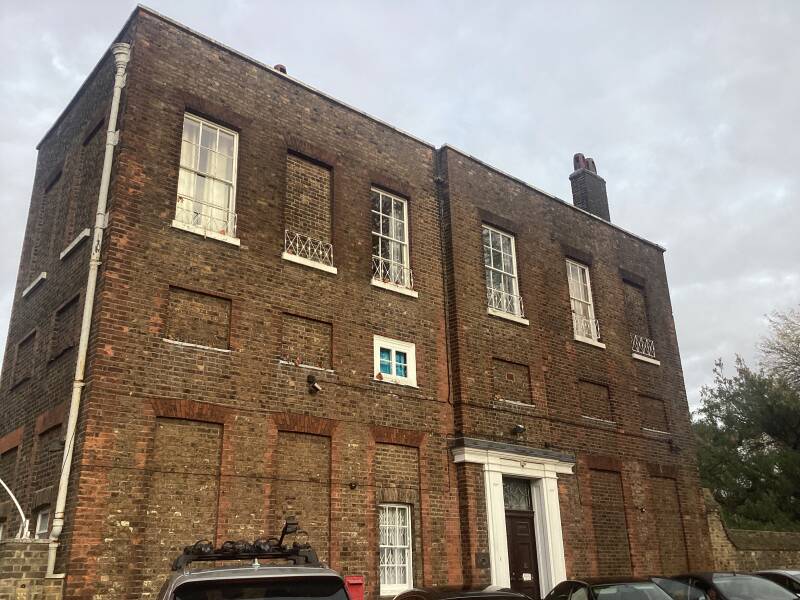
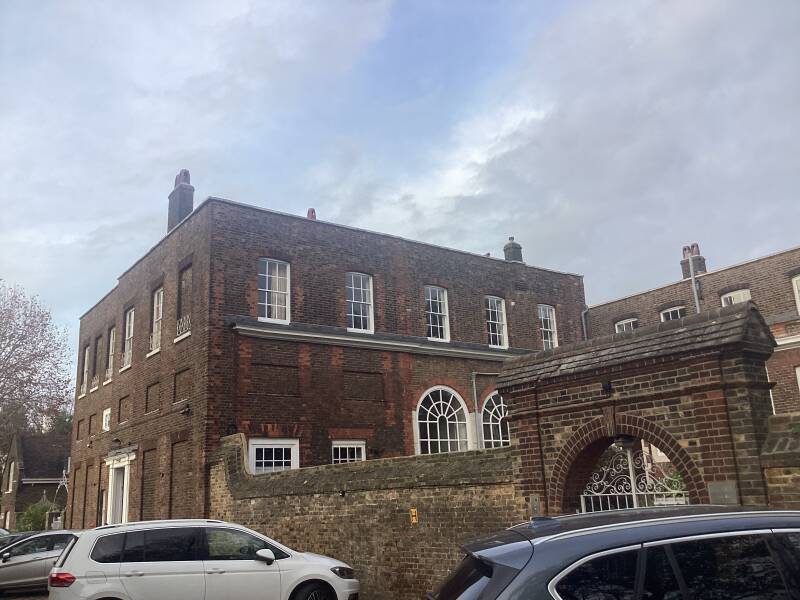
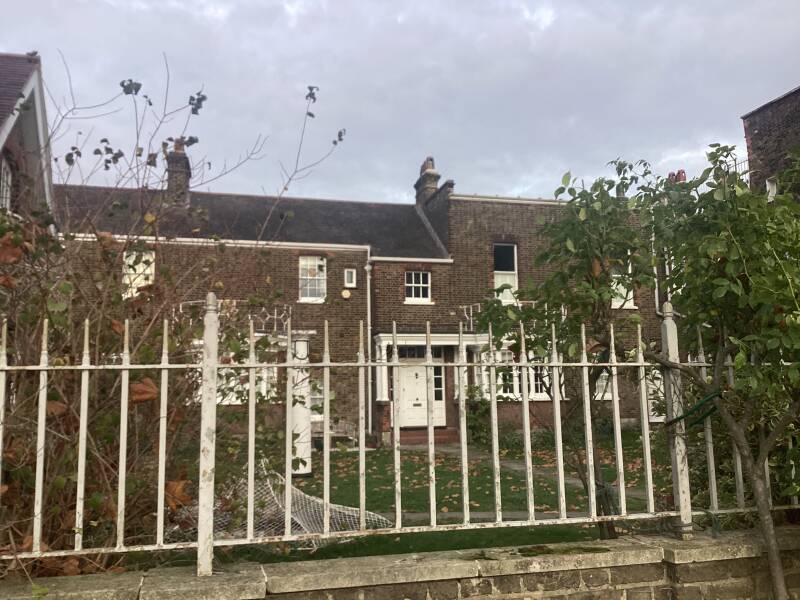
An attractive 18th century house on the western edge of the Park, Macartney House was home to the parents of General James Wolfe (1727-1759). He was educated in Greenwich and it was from here that he left for Canada and the battle for Quebec in 1759 in which he was killed. His body was brought back and lay in the house until his burial at St Alfege Church, Greenwich.
Macartney House comprises two 17th century houses which had been combined into a single dwelling by 1717. The house was extended by architect Sir John Soane (1753-1837) for George Fulke, Baron Lyttleton, who was descended from the Macartneys of Auchinleck. The property was divided into privately owned flats in 1926-27.
E2 refurbished and reconfigured the north wing of the grand Grade II Listed Macartney House, situated on the south western park wall to Greenwich Park.
Once occupied by the family of General James Wolfe, commemorated with a statue in the Royal Park, the vast Grade II building, which was previously altered by Sir John Soane, has been brought up to date.
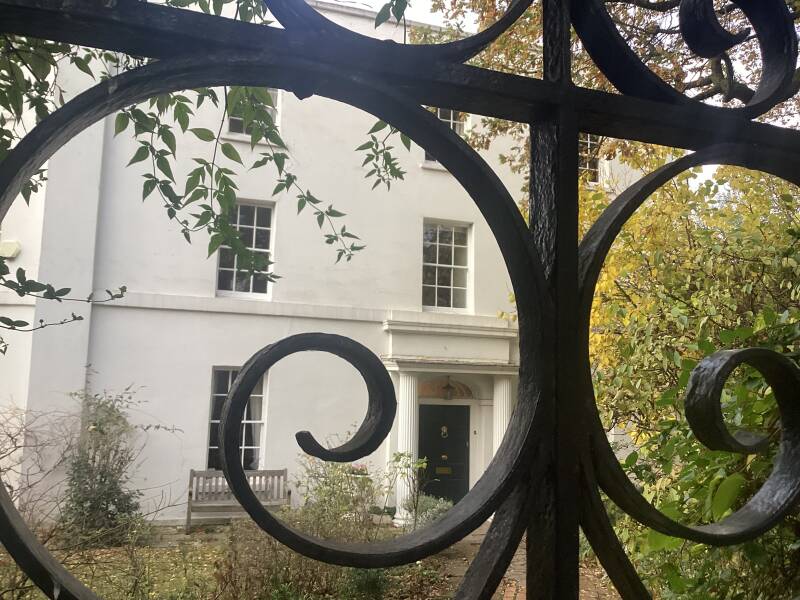
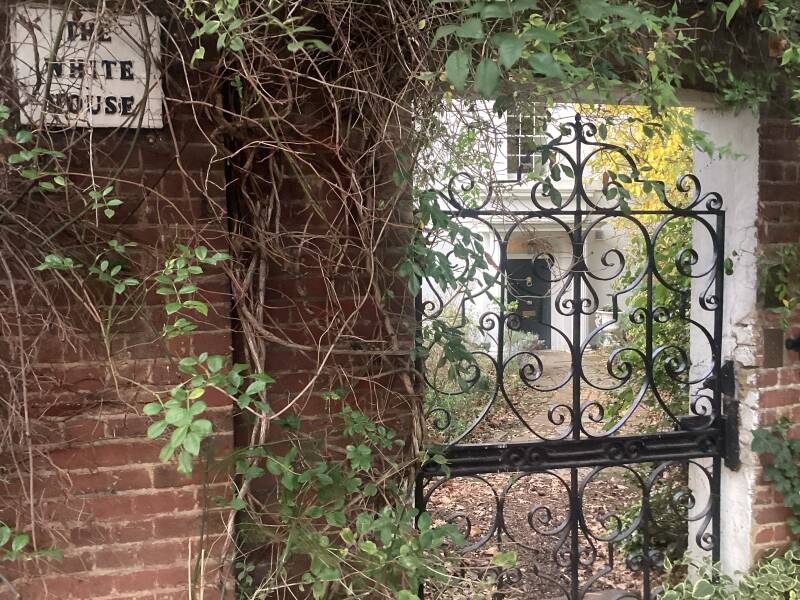
THE WHITE HOUSE
Kent Waterworks reservoir (inside railings, disused)
1,250,000 gal. 158' above OD. They were built following an agreement with the Admiralty in 1846 to protect the Hospital from fire and to take water to Deptford Dockyard and the Royal Hospital.
However it has also been said to belong to the Kent Waterworks Company based on Brookmill Road to the south. It is not accessible by the public and has developed as a wild life area. It was covered in 1871. It was used as an air raid shelter in the Second World War and was fitted with toilets and other accessories.
Tennis courts
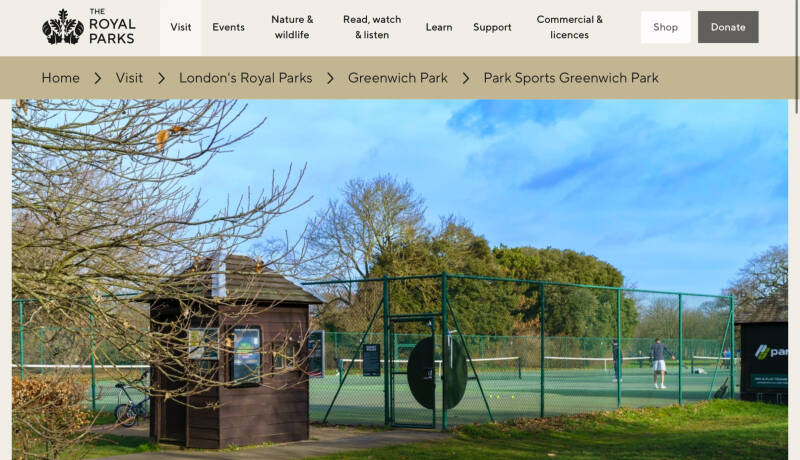
Cricket ground

Cherry Blossoms


BACK to the main route: As you are aproaching the Royal Observatory along The Avenue…
Here you have a plan… to devise what you see from outside and inside if you decide to visit
Blackheath AVENUE
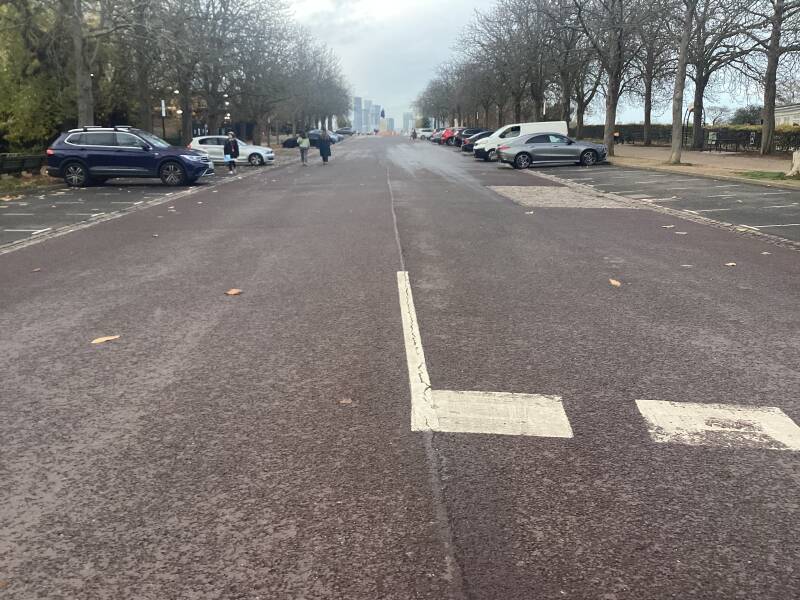
The ROYAL OBSERVATORY
First Light Project

ALTAZIMUTH PAVILION, housing the ANNIE MAUNDER ASTROGRAPHIC TELESCOPE
The pavilion’s unusual name comes from the name of the telescope it originally housed. It sat on what is called an ‘altazimuth’ mount. This one term is made up of the terms altitude and azimuth. Such a mount allows an instrument to move in altitude (up and down, measured in degrees from 0 degrees on the horizon to 90 degrees when pointing straight up), and azimuth (left and right, measured in degrees from 0 starting in the north, moving clockwise through 90 degrees east, 180 degrees south, 270 degrees west and back to 0 degrees north).
Here a modern 21st-century observatory nestled in its 19th-century home: is called an ‘astrographic’ suite of telescopes because they are designed to be used photographically with digital cameras rather than simply with the human eye.
PETER HARRISON PLANETARIUM
Harrison worked as an executive for the Ford Motor Company, Firth Cleveland, and Crest Nicholson, which bought a company called Chernikeeff, a maker of marine instruments. In 1978, he borrowed the money to buy out this business, seeing that its instrument technology would become important in communications. The company developed Telex messaging and later became the British distributor of the internet routers of Cisco Systems. In 1999, he sold Chernikeeff for £300 million.[1][3]
SOUTH BUILDING and PLANETARIUM
Originally known as the New Physical Building or New Physical Observatory, the South Building was constructed between 1891 and 1899. It incorporates the dome of a short-lived building constructed at the Observatory in the early 1880s to hold the Lassell telescope. The histories of the two buildings are so intertwined, that they are best dealt with together. As their story unfolds, it becomes clear how much less straightforward Christie was as Astronomer Royal than his predecessor Airy. Christie continually moves the goal posts as he seeks to equip the Observatory with large telescopes – telescopes it has to be said, for which there was no pressing need (other than to keep up with Observatories elsewhere).
STATUE OF YURI GAGARIN
This statue was first installed on The Mall, on the small piazza just to the west of the British Council Building at Admiralty Arch. The arrival of the statue marked the 50th anniversary of Gagarin’s first earth orbit (12 April 1961). It was installed on 14 July 2011 exactly 50 years after Gagarin's only visit to the UK and on the spot where he met the Prime Minister Harold MacMillan.
THE PAVILION cafe
GENERAL WOLFE Statue

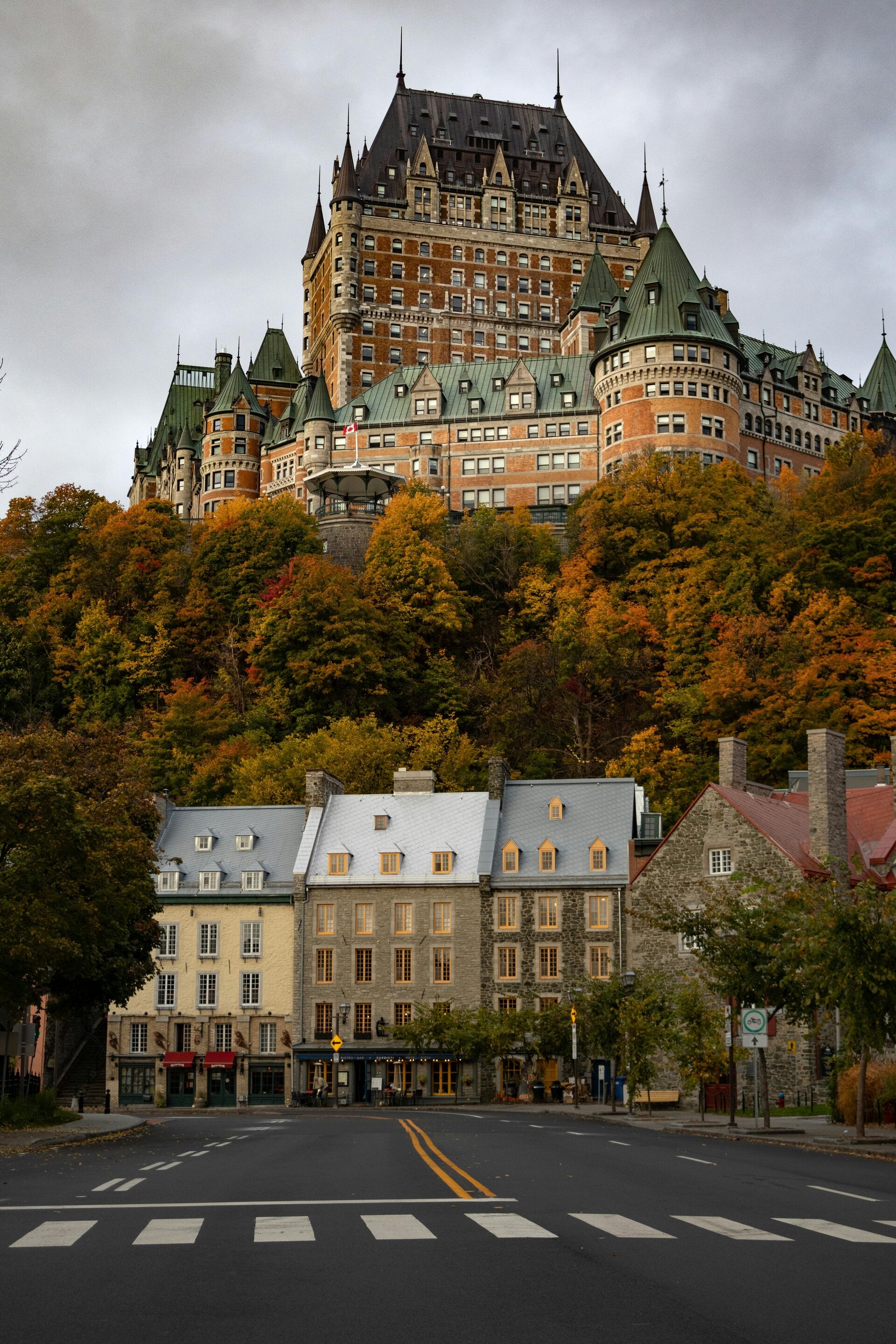
General Wolfe had lived most of his life in Greenwich, with his later years spent at Macartney House overlooking the park on the west side. He joined the army at the age of 14 and rapidly ascended the ranks – becoming Major General in 1759 at the age of 32. At that time, Britain had been at war with France for five years, and Wolfe was immediately dispatched to Canada to lay siege to the French colony of Quebec. Unveiled on 5 June 1930 as a gift from the Canadian people.
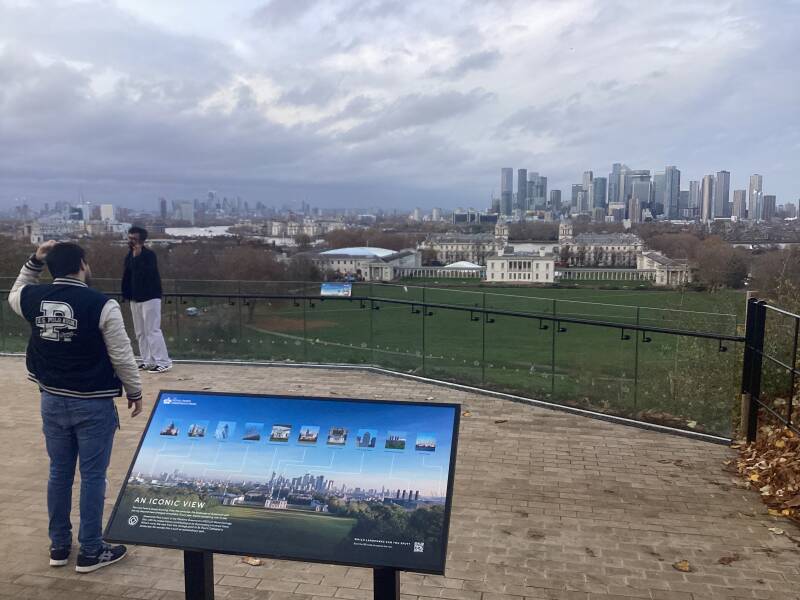
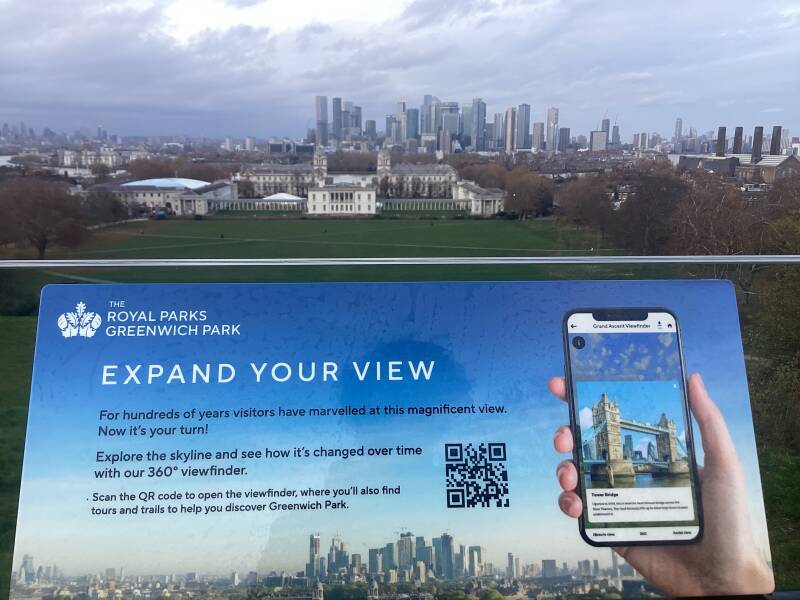
The first ROYAL OBSERVATORY
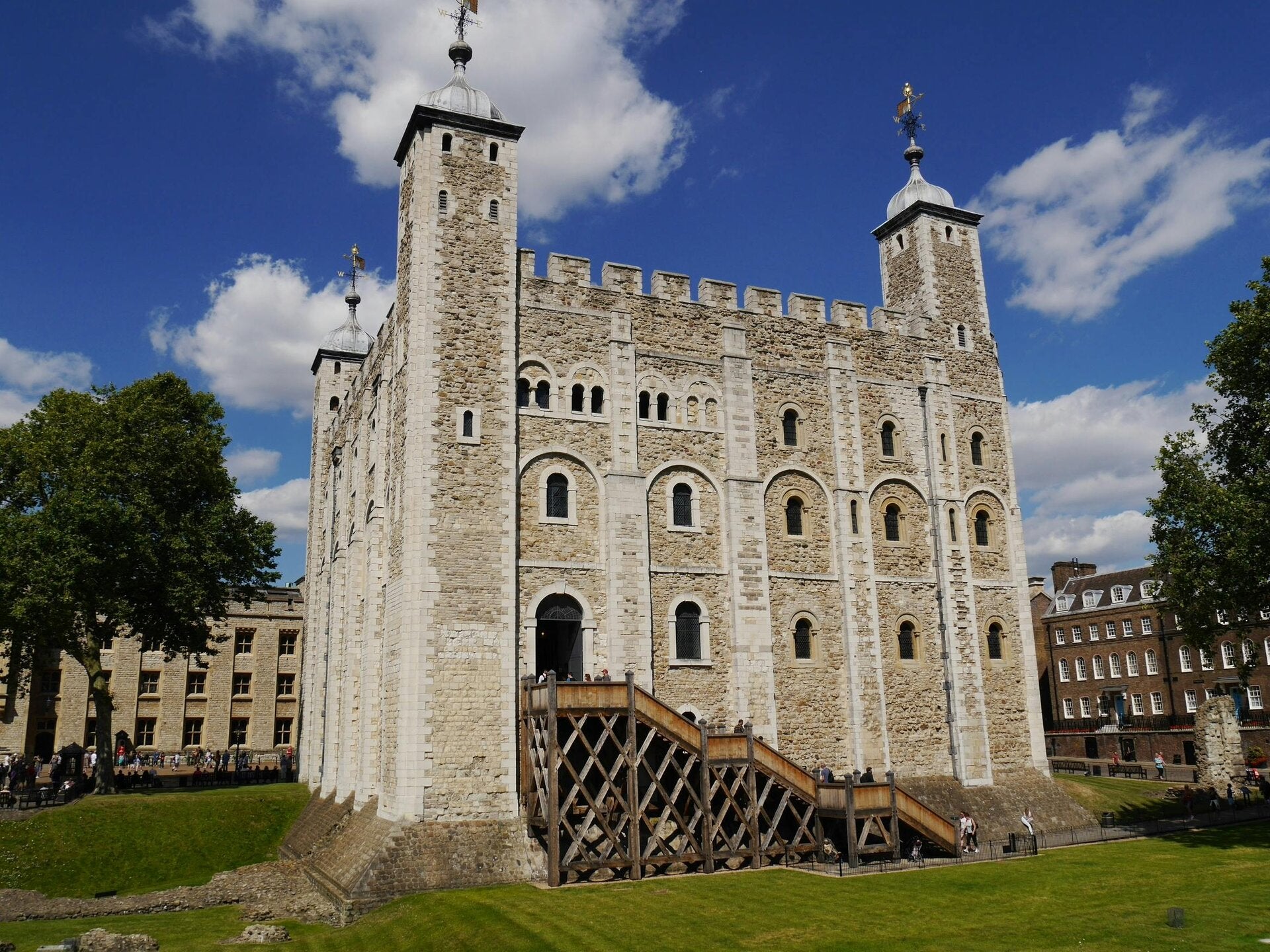
The WHITE TOWER served as the site for Britain's first temporary royal observatory in 1675 before the permanent Royal Observatory in Greenwich was built.
John Flamsteed, appointed as the first Astronomer Royal, made initial astronomical observations from a turret of the White Tower while a new observatory building designed by Sir Christopher Wren was under construction in Greenwich.

THANK YOU TO THE LONDON PASS https://londonpass.com/en/things-to-do/did-you-know-10-facts-about-the-royal-observatory-greenwich
WREN

Before Sir Christopher Wren designed iconic landmarks like St. Paul’s, he was a professor of astronomy at Oxford University. It was under this role that he was selected by King Charles II to establish the Royal Observatory Greenwich. Wren then chose the site at Greenwich, thus setting the stage for the Observatory's grand history.
ASTRONOMER ROYAL
As European exploration and international trade picked up, King Charles II was encouraged to establish an observatory that could aid in the understanding of astronomy and navigation. When founding the Royal Observatory he also created the post of Astronomer Royal.
John Flamsteed became the first person appointed to the position. There have been only 15 Astronomers Royal since Charles II created the position in the late 17th century. You can learn all about them during your visit to the Observatory.
The old churchyard, St Margaret’s Lee: the burial place of Halley, Bliss and Pond – the second, fourth and sixth Astronomers Royal (see chapter)
The intriguing story of how they came to be buried at Lee rather than at St Alphege’s in Greenwich in which parish the Observatory is located, leaves many questions unanswered. So too does the available information on the restoration of Halley’s tomb in 1854.
CLOCK (it is 4 minuts part 16 h. BWT, 11/11/25, that is the same as GMT. BST is GMT+1)
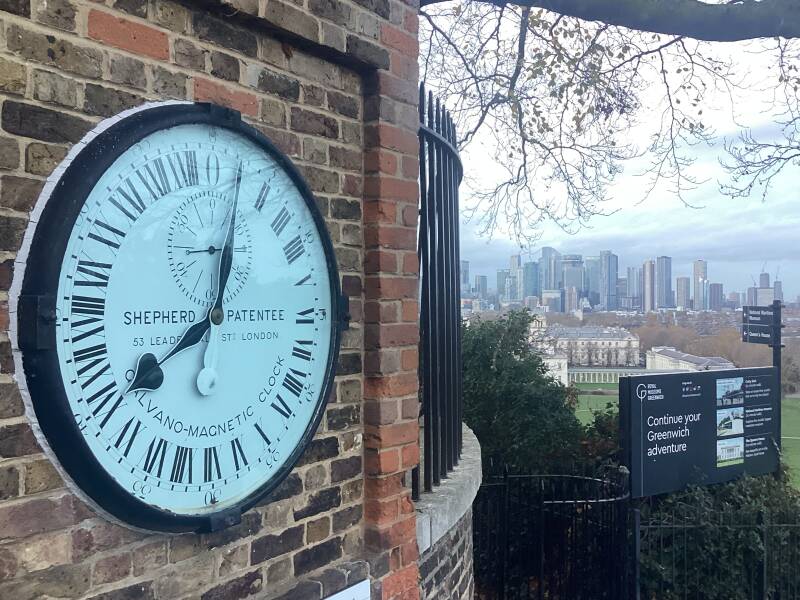
As the industrial world came into shape, trains, factories and global businesses could use Greenwich Mean Time as a universal measure of time, streamlining the timings of journeys, transactions and production periods across the whole planet.
So many clocks in London…
IMPERIAL MEASUREMENTS. Public standards of length

The Royal Observatory Greenwich features a set of Public Standards of Length. Marked out by brass pegs, these measurements set out the exact length of different imperial measurement units, including a yard and a foot.
INTERNATIONAL MERIDIAN CONFERENCE OF WASHINGTON
It was the emergence of new technologies, in particular the railways in the 1830s, that forced a wider reform of the time system, and with it the adoption of a single Prime Meridian. Whilst local time had sufficed in the age of the horse drawn carriage, it was inappropriate for the railways. When it was midday local time in Bristol for example, it was already ten past twelve in London some 100 miles to the east. In order to make the timetable workable, instead of using local times, the railway companies introduced a single standard time across their network. In mainland Britain, this was Greenwich Mean Time – a time that was chosen because time signals were available directly from the Royal Observatory at Greenwich via the electric telegraph. In mainland Britain however, the time difference between the most easterly and westerly points is only about 30 minutes – significantly less than the four hours on mainland USA.
The Prime Meridian was chosen by the International Meridian Conference in 1884, which was held in Washington, D.C., to establish a global standard for time and longitude.
ORDNANCE SURVEY MARKER
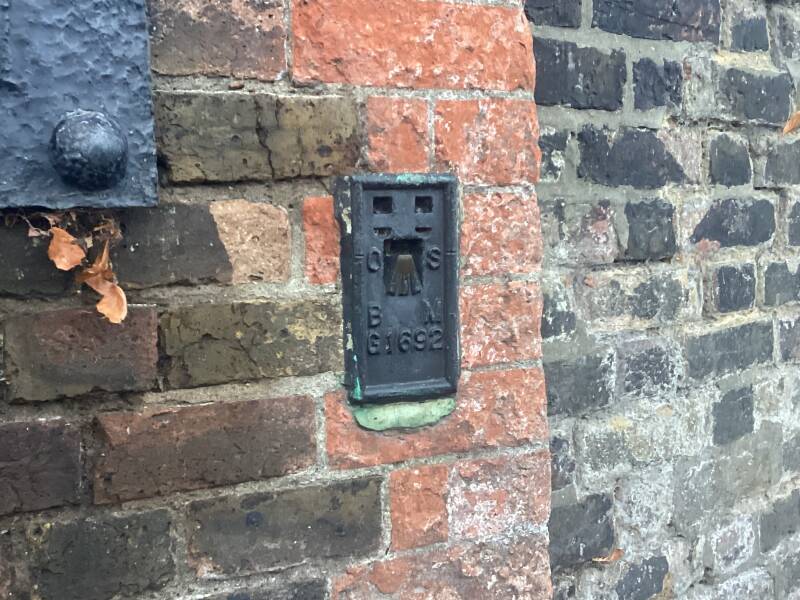
Ordnance Survey (OS) markers are survey marks, primarily benchmarks, that recorded height above sea level across Great Britain, though they are no longer maintained as modern GPS technology is used instead. You can find them etched into buildings, bridges, and other structures, often as a broad arrow pointing to a horizontal line, and also as metal "flush brackets" at the base of trig pillars
MERIDIAN COURTYARD & LINE
The Airy Transit Circle telescope
FLAMSTEAD HOUSE. THE OCTAGON ROOM

Flamsteed House is the original Royal Observatory building at Greenwich. King Charles II instructed Wren, who was also an astronomer, to design the building in 1675 and it was completed the following year.
Time and Longitude
Time and Longitude tells the story of the quest to find longitude at sea in the age before satellite navigation, and showcases Harrison's celebrated sea clocks.
At sea, navigation is a matter of life and death. Out of sight of land, how can you tell where you are?.
By 1700, skilled seamen could find their position north or south (their latitude), but still lacked accurate instruments or methods to calculate their east-west position, known as longitude.
The Harrison Clocks
John Harrison's H4 is the most important timekeeper ever made. It is the machine that helped solve the problem of keeping accurate time at sea
Time and society gallery
explores the impact of timekeeping on everyday life. Other museums have galleries that focus on time and society, such as the Clockmakers' Museum
Great Equatorial Telescope & dome
The 28-inch refracting telescope at the Royal Observatory Greenwich is the largest of its kind in the UK.
Built by the Grubb Telescope Company in Dublin and installed in 1893, the telescope was originally designed to be used for astrophotography. However, it quickly became vital to the Royal Observatory's research into double stars.
Anyone visiting Greenwich can see the telescope's distinctive 'onion dome' roof when they look up towards the Royal Observatory.
Astronomers Garden
Lower Garden
Flamstead’s hidden telescope?. Inside a well!
Hooke and Wren…Remember THE MONUMENT?
The Monument to the Great Fire of London, designed by Robert Hooke and Sir Christopher Wren, was built to function as a giant zenith telescope. While it served as a memorial, its hollow column was intended for scientific experiments, with a small laboratory in the basement. The plan failed due to vibrations from London traffic, making accurate astronomical readings impossible, though Hooke still used it for other experiments like pendulum observation
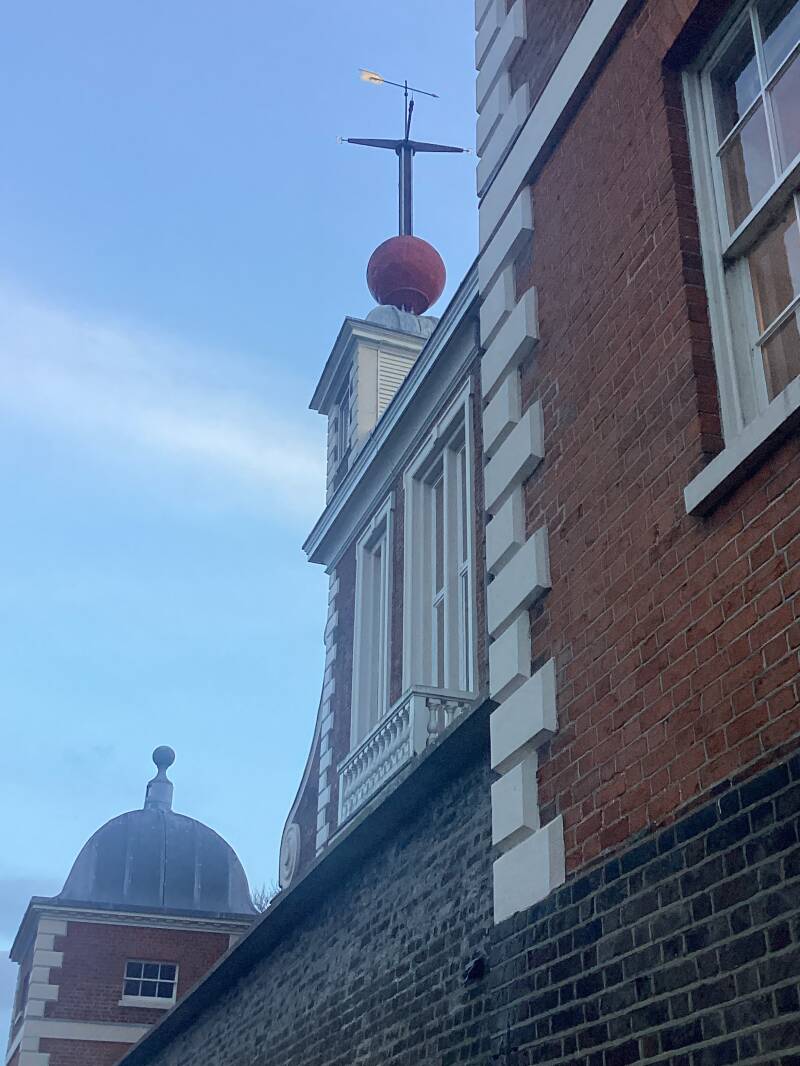
The RED TIME BALL
A bright red Time Ball sits on top of Flamsteed House, one of the main buildings of the Observatory complex. The ball rises to the top of its mast each day, beginning its ascent at 12.55pm, before dropping at exactly 1pm.
Considered one of the earliest public time signalling devices in the world, it first dropped in 1833.
MERIDIAN LINE
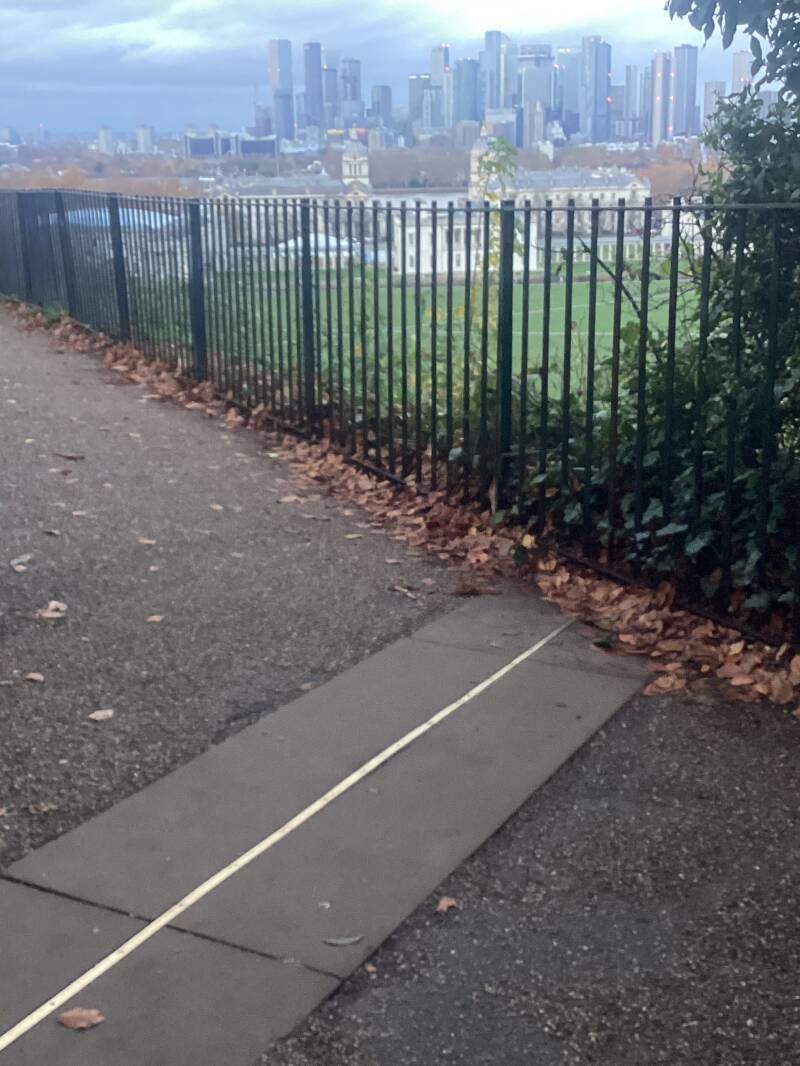
How does the Royal Observatory Greenwich set the time? Well, it's most famous for being the home of the Prime Meridian. This longitudinal marker is essentially Longitude 0, it standardised time in the form of Greenwich Mean Time (GMT). This changed the game for everything from navigation to global businesses.
Standardisation was hugely beneficial when it came to mapping the night sky, with separate observation points able to be recorded in terms of their distance from the Prime Meridian. It was also incalculably useful in terms of seafaring, with distances, times and routes able to be mapped effectively because of the use of a standard longitudinal point.
The Royal Observatory Greenwich Prime Meridian facts are impressive. It literally divides the world into the western and eastern hemispheres. Every point on Earth was measured in relation to its distance east or west of the Prime Meridian.
Stand on either side of that line, and you're straddling the two halves of our planet.
EDMUND HALLEY original TOMBSTONE
CAMERA OBSCURA

A precursor to the photographic camera, it is also known as a pinhole image. A natural optical phenomenon, it occurs when an obstructed image is displayed through a small hole. When the image is reversed and inverted onto an opposite wall, it offers the viewer a close up look at the image. This method was originally used to study eclipses, without needing to look at the sun.

Along Blackheath Avenue, towards Blackheath

BLACKHEATH GATE
BLACKHEATH LODGE
CORNISH REBELS MEMORIAL

{Original Cornish:}
Rak perthy cofa, Myghal Josep an Gof ha Thomas Flamank, hembrynkysy an Gernowyon a geskerdhas bys dhe Loundres. Y a vu fethys omma ha godhevel dyalans dhe Dyburn 27 ans Mys Metheven 1497,
Y a’s tevyth hanow a bes vynytha ha bry a dhur hep merwel.
Drehevys gans Cowethas Kernewek Loundres ha’n Orseth Kernow 21 ans Mys Metheven 1997
Res gans Leghven Delabol.
{English Translation:}
In memory of Michael Joseph the smith and Thomas Flamank, leaders of the Cornish who marched to London. They were defeated here and suffered execution at Tyburn 27th June 1497.
They shall have a name perpetual and fame permanent and immortal.
Erected by the London Cornish Association and the Cornish Gorsedd 21st June 1997.
Donated by Delabole Slate.

From here, follow the “GRAND AXIS”, across the Blackheath (the park) to ALL SAINTS Church and Blackheath village. See next chapter
Still inside park, alongside the SW part of the wall
Site of MONTAGU HOUSE
QUEEN CAROLINE’S BATH
A bath beneath the paving and this wall are all that remain of Montague House the home between 1801 and 1813 of the Princess of Wales, later to become Queen Caroline, wife of George IV.
On the sequence of events the plaque is not clear. Caroline married George in 1795 and after the birth of their daughter they separated and Caroline came to live here in Montague House 1801-13. In 1814 she left Britain
IGNATIUS SANCHO MEMORIAL
Ignatius Sancho, c1729 - 1780, African man of letters, composer and opponent of slavery, born on a slave ship he was encouraged to educate himself by John 2nd Duke of Montagu and served as the butler to the Duchess (Daughter of John Churchill, 1st Duke of Marlborough) here in Montague House.
RANGER’S HOUSE

Ranger’s House is an elegant Georgian villa, now best known as the exterior of the Bridgerton home in the award-winning Netflix series.
The collection was gathered by the fabulously wealthy Sir Julius Wernher, who could buy the very best and had a passion for what he called the ‘splendidly ugly’ – tiny, unusual artworks expertly crafted in rich materials.
You’ll see nearly 700 varied works of art, including Dutch Old Masters, fine Renaissance bronzes and silver treasures, medieval and Renaissance jewellery and tapestries with scenes of Chinese life.
ROSE GARDEN


Former drinking fountain
West Grove
Dartmouth Terrace
DARTMOUTH ESTATE
Dartmouth Grove
RED HOUSE?
JAMES GLAISHER
James Glaisher is the best known of Airy’s many assistants. He was a pioneer both of weather forecasting and of photography. He also held, with Henry Coxwell, the world record for the highest altitude reached in a balloon. Of independent mind, his relationship with Airy wasn’t always the smoothest. A petty admonishment over his timekeeping led directly to his resignation in 1874.
Glaisher was born in 1809 to James and Mary Glaisher of Rotherhithe. Although some accounts state that his father was a watchmaker, the 1841 and 1851 censuses record him as a tailor
Morden Hill (street) and Connington Road
Site of HOSPITAL
Elverson Road DLR Station
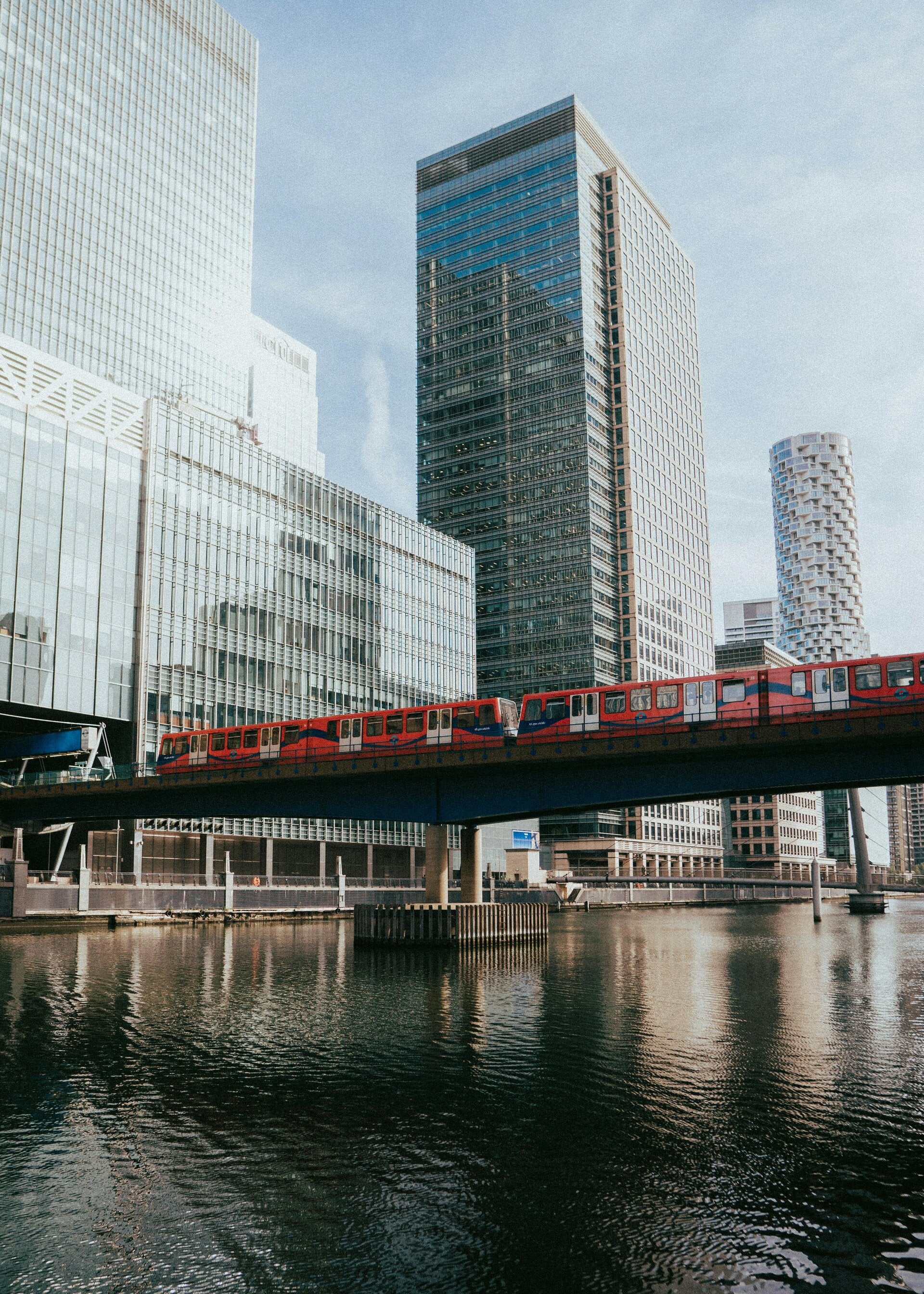
The surname Elverson is a patronymic name, meaning it indicates a relationship or descent. It originates from the Middle English personal name Alfher (Old English Ælfhere) combined with the suffix "-son", signifying "son of Alfher".
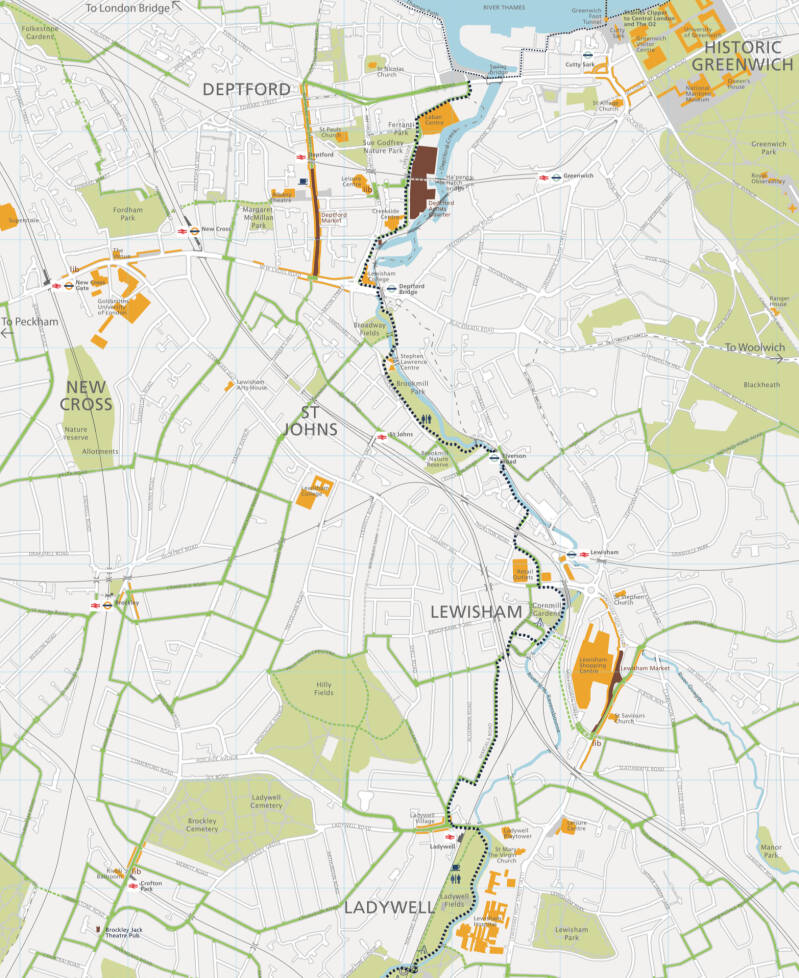

Keep enjoying this guide!

Donate, help, get involved…

